| 正面 | 5885.ant 英 [ænt]美 [ænt]     |
|---|---|
| 背面 |     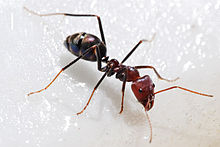 释义: 记忆方法:偷窃被拷打n. 蚂蚁n. (Ant)人名;(土、芬)安特 例句: 1. One ant - hole may cause the collapse of a thousand - li dyke.千里长堤,溃于蚁穴. ant 蚂蚁来自古英语aemette,蚂蚁,来自West Germanic*amaitjo,砍下,来自*ai,离开,去掉,*mai,砍, 切,词源同maim.字面意思即砍下,切开,引申词义分段,成段,用于指蚂蚁。 antant: [OE] The word ant appears to carry the etymological sense ‘creature that cuts off or bites off’. Its Old English form, æmette, was derived from a hypothetical Germanic compound *aimaitjōn, formed from the prefix *ai- ‘off, away’ and the root *mait- ‘cut’ (modern German has the verb meissen ‘chisel, carve’): thus, ‘the biter’.The Old English word later developed along two distinct strands: in one, it became emmet, which survived into the 20th century as a dialectal form; while in the other it progressed through amete and ampte to modern English ant. If the notion of ‘biting’ in the naming of the ant is restricted to the Germanic languages (German has ameise), the observation that it and its nest smell of urine has been brought into play far more widely.The Indo-European root *meigh-, from which ultimately we get micturate ‘urinate’ [18], was also the source of several words for ‘ant’, including Greek múrmēx (origin of English myrmecology ‘study of ants’, and also perhaps of myrmidon [14] ‘faithful follower’, from the Myrmidons, a legendary Greek people who loyally followed their king Achilles in the Trojan war, and who were said originally to have been created from ants), Latin formīca (hence English formic acid [18], produced by ants, and formaldehyde [19]), and Danish myre.It also produced Middle English mire ‘ant’, the underlying meaning of which was subsequently reinforced by the addition of piss to give pismire, which again survived dialectally into the 20th century.ant (n.)c. 1500, from Middle English ampte (late 14c.), from Old English æmette "ant," from West Germanic *amaitjo (cognates: Old High German ameiza, German Ameise) from a compound of bases *ai- "off, away" + *mai- "cut," from PIE *mai- "to cut" (cognates: maim). Thus the insect's name is, etymologically, "the biter off." As þycke as ameten crepeþ in an amete hulle [chronicle of Robert of Gloucester, 1297] Emmet survived into 20c. as an alternative form. White ant "termite" is from 1729. To have ants in one's pants "be nervous and fidgety" is from 1934, made current by a popular song; antsy embodies the same notion." |